Playing with tape, projectors, Wicky Sticks and so much more!
Accessible approaches to collaborative drawing with visually impaired students
Led by Sara Dudman RWA at The Thelma Hulbert Gallery, 2016
Working together with feeling, sensing, sticking, video and light projection…..in an amazing workshop day at the Thelma Hulbert Gallery in Devon, I worked alongside teachers and children from WESC Foundation Specialist Centre for Visual Impairment to explore and develop accessible practical approaches to responding to ‘Hock Together’, an exhibition of 2D paintings, drawings and video by Sara Dudman and Debbie Locke.


The traditional starting point of engaging first-hand with the exhibition focussed on students experiencing the artists’ video installation which included a range of sights and sounds gathered by sheep and the farmer wearing webcams to capture a standard day on a working sheep farm. Students listened and really felt as if they were on the farm, recognising sounds and using them to build imaginary visual pictures. The artists had collected video footage and mapping data using webcams and GPS which they had then used as starting points for their collaborative painted and drawn artworks in the exhibition.
Practical activities centred around experimenting with definitions of drawing, including exploring ways to make tactile and other drawings. OHP projectors were used to create large scale collaborative wall drawings. Collaboration was a strongly recurring theme throughout the day.


Students and teachers worked from a short series of OHP projections of simple line drawings. The key ingredients here were the simplification of the more complex video source material into very bold and simple black marker pen line drawings.
When projected, not only was the line drawing enlarged to aid visual perception, but also the strong contrast in light helped students perceive the lines and imagery.
Projecting directly onto the wall at student height allowed participants to get as close as necessary and draw directly onto the large paper attached to the wall.
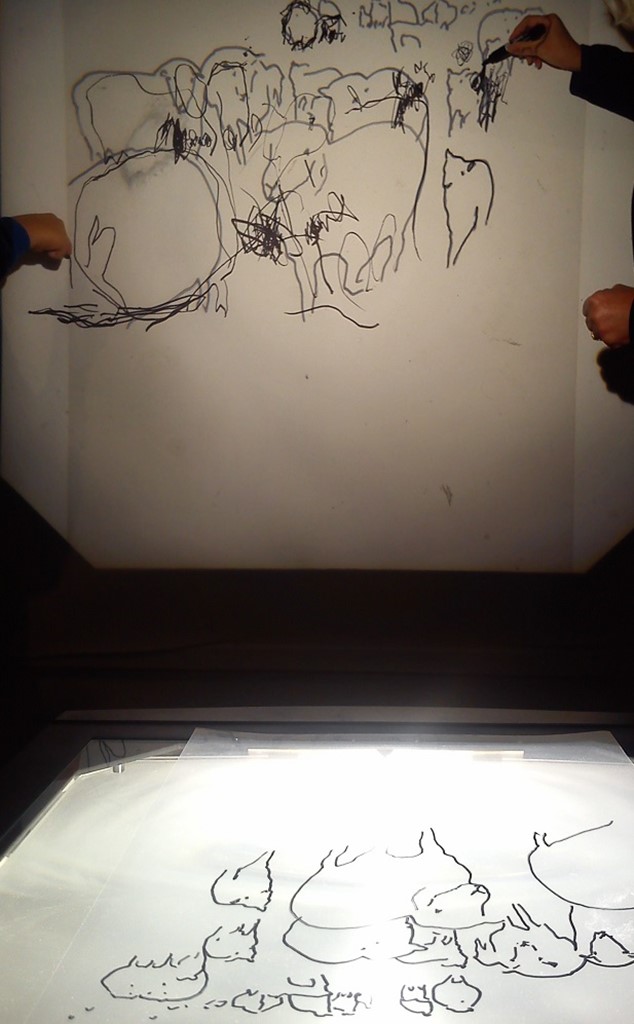
One of the benefits of working on a drawing on this scale was the opportunity for students to work with enlarged imagery, enabling conversations about perspective, centring on the different sizes of the sheep and the spatial perspective with links across to the visually impaired students’ own experience of the world around them.
Parallels were drawn between visual perspective and audible distance – ie: sounds are quieter the further away you are which corresponds with images appearing the become smaller.
Everyone worked brilliantly to also create tactile drawings using specialist materials including ‘German Film’ and embossing tools. ‘The tactile experience of perceiving the image was used as a catalyst for conversations about the image and exhibition content.


The students followed up their initial collaborative marker pen drawing with a collaborative tape wall drawing. Wicky Sticks were included as a drawing medium alongside the coloured tapes. The combination of the visually strong and clear lines created with the brightly coloured tape, together with the tactile qualities created with tape and Wicky Sticks enabled all students to interact with and contribute to the drawing.
Physical contact with profoundly visually impaired students to support, guide and model processes and techniques is essential. During the creation of the collaborative OHP wall drawing students enjoyed knowing that they ‘had sheep on their backs’ even if they couldn’t see them. To assist understanding, Sara ‘drew’ around the shape of the projected sheep using her fingers as a drawing tool, touching the students’ backs and verbally describing the shape as they went so students could imagine the shapes of the sheep.
This idea was then developed using tape directly onto the students’ back to capture the projection of the sheep. The students responded wonderfully to this experience, enjoying feeling the drawing of the shape of the sheep through their sweatshirts as it’s shape was traced out on their backs.
This workshop offered all involved a great opportunity to experiment and develop accessible ideas and approaches in response to the students’ needs.